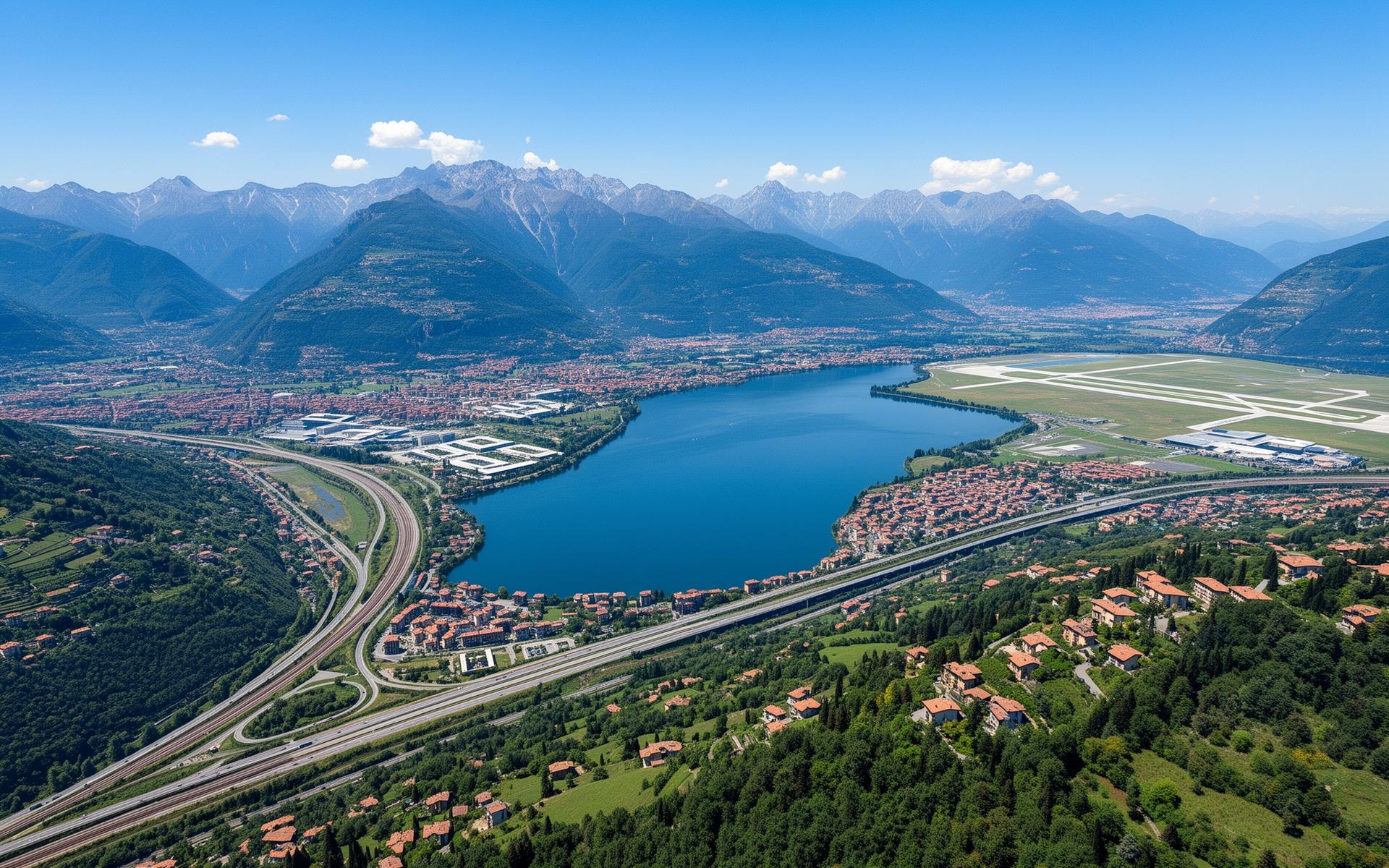
Can Northern Italy Absorb 62,000 m²? The Lake Maggiore Thesis
For Futuro Agrate, selling or absorbing roughly 62,000 m² is realistic — provided the project is phased correctly, positioned internationally, and conceived as a curated lifestyle destination rather than generic stock. Here is the market case.
The Core Question
For Futuro Agrate, the question is not "can 62,000 m² be sold at all?" — it is "under what structure does this volume become a natural, multi-cycle absorption?"
The honest answer, supported by Savills, Knight Frank, and regional Lake Maggiore research: this volume is large, but absolutely realistic for Northern Italy — provided four conditions are met:
- •Phased development in waves of 8–15k m².
- •Mixed-use concept rather than monoculture residential.
- •International marketing, not only local Italian buyers.
- •Right land entry price, which Futuro Agrate already holds.
Below is the market case for each.
1. Northern Italy and the Lake Region Are Still Growing
Per Savills Italy Prime Residential Market 2024:
- •The Italian prime residential market grew even through the high-interest-rate cycle.
- •Second-home locations outperformed cities.
- •Northern Italian lake areas remain one of the most resilient segments.
- •Demand is structurally shifting toward space, nature, and lifestyle developments.
Specifically for Lake Maggiore:
- •Strong growth in both rental and capital values.
- •Persistently high international demand.
- •Premium supply is structurally constrained by strict zoning regulation.
2. Lake Maggiore Is Already an International Market
Regional market research for 2025–2026 shows:
- •45–60% of buyers are non-Italian.
- •Active demand from Germany, Switzerland, the United States, and Eastern Europe.
- •The lake is perceived as a safe haven for capital.
The implication for Futuro Agrate is decisive: the project is not constrained to a local Italian buyer pool. It can be marketed and absorbed as an international lifestyle asset.
3. 62,000 m² Is Not a Single Sale
The classic investor mistake is to treat 62,000 m² as a one-shot disposal. In reality, master-developments at this scale absorb through:
- •Phased delivery (8–15k m² per wave),
- •Multiple product formats, and
- •Differentiated micro-markets within the same masterplan.
A realistic mix for Futuro Agrate:
| Format | Indicative share |
|---|---|
| Residences | 20–25% |
| Serviced apartments | 10–15% |
| Hospitality (5★ + boutique) | 10–15% |
| Villas | 15–20% |
| Sport / wellness | 5–10% |
| Senior lifestyle | 5–10% |
| Branded residences | 10–15% |
| Eco-housing | 5–10% |
Northern Italy easily absorbs 8–15k m² per wave in this configuration.
4. Constrained New Supply Is a Major Advantage
- •New construction around the lakes is heavily restricted.
- •The premium supply pipeline remains low.
- •Historically, scarcity is the single strongest price support in this market.
Practical consequence: Futuro Agrate will not compete against mass new construction. Its real competition is the fragmented villa market — slower to transact, less curated, less amenitised.
5. Prices Validate the Model
- •Prime lake properties transact at €8,000–10,000+/m².
- •Quality non-prime regional product trades below that, but with stable demand.
Even on a deliberately conservative blend of €4,500–7,000/m² mixed-use, 62,000 m² produces a serious GDV in the high hundreds of millions.
6. The Decisive Variable Is Concept
Today’s market poorly absorbs:
- •Generic "houses",
- •Generic "apartments".
Today’s market strongly absorbs:
- •Curated lifestyle,
- •Wellness,
- •Nature living,
- •Club format,
- •Privacy,
- •Eco-premium,
- •Integrated communities.
This is exactly where Futuro Agrate plays. The asset is not "a development" — it is the opportunity to create a new residential destination at the intersection of Lake Maggiore and the Milan corridor.
Conclusion
From a market perspective:
- •62,000 m² in Northern Italy is large but absolutely realistic;
- •under phased development;
- •in a mixed-use concept;
- •with international marketing;
- •and a correct land entry price.
The decisive question is not "can 62,000 m² be sold?" but how the masterplan, phased exits, international positioning and concept quality are engineered to attract the lifestyle buyer — not only the local residential one.
Futuro Agrate is structured precisely to answer that question.
Editorial note: this article is for information purposes and does not constitute investment advice.
Contact our London office to discuss SPV co-investment and arrange a site visit.
Sources and verification
Primary sources consulted
- Agenzia delle Entrate — OMI — Osservatorio del Mercato Immobiliare, half-yearly quotations agenziaentrate.gov.it
- Nomisma — Osservatorio sul Mercato Immobiliare
- ISTAT — Demography, housing and regional accounts series istat.it
- Comune di Agrate Conturbia — Planning instruments and building-rights documentation
Figures presented as ranges, uplifts or returns are model estimates based on the sources below. They are not measurements of this site and not a promise of performance.
Read the Journal by interest rather than by publication date. Each path is a sequence, not an archive.
The investor journey
8 articlesFrom how development value is created before construction to how integrated schemes are underwritten.
You are here · Step 5 of 8
- 1How Land Consolidation Creates Development Value
- 2Why Planning Rights Can Be More Valuable Than Construction
- 3Senior Secured Development Finance Explained
- 4How Institutional Investors Assess Integrated Developments
- 5Why Phasing Matters More Than the Final Masterplan
- 6Does Combining Residential, Hospitality, Wellness and Sport Actually Work?
- 7What Can Go Wrong in a Multi-Use Lifestyle Development?In research
- 8The Integrated Community as a Long-Term Investment and Living ModelIn research
The living journey
8 articlesWhat changes in how people want to live, and what a low-density community must deliver in return.
- 1Why Affluent Households Are Reconsidering Large-City LivingIn research
- 2Luxury Is Becoming Time, Privacy and ConvenienceIn research
- 3The Rise of the 15-Minute Lifestyle Beyond the CityIn research
- 4Why Nature Is Becoming an Economic AssetIn research
- 5From Second Home to Second LifeIn research
- 6How Far Are People Actually Willing to Walk?In research
- 7Why Residential Value Depends on Everything Outside the Home
- 8How a Large Estate Can Feel IntimateIn research
The operator journey
7 articlesDemand, seasonality and critical mass for hospitality, wellness, sport and food & beverage.
- 1Why Hospitality Can Accelerate Residential Demand
- 2Can Hotels and Permanent Residents Successfully Share One Destination?In research
- 3The Economics of a Food and Beverage EcosystemIn research
- 4From Spa to Everyday WellnessIn research
- 5Who Pays for Wellness and Why?In research
- 6Can Sport Reduce Seasonality?
- 7How Much Population Does an Integrated Community Need?In research
The regional brief
5 articlesNorthern Italy read as a residential and investment region rather than as a holiday destination.
- 1Northern Italy as a European Residential and Investment Region
- 2The Milan–Lake Maggiore–Swiss CorridorIn research
- 3Why Piedmont Remains Less Expensive Than Better-Known Italian Regions
- 4Climate, Landscape and Year-Round Liveability in Northern ItalyIn research
- 5Can Piedmont Become a Global Lifestyle Destination?
Investment, Planning and Value Creation
Article 5 of 5How Institutional Investors Assess Integrated Developments
Does Combining Residential, Hospitality, Wellness and Sport Actually Work?