Lake Maggiore Region: €4.2B Infrastructure Investment Plan 2025-2030
The Piemonte region is set to receive unprecedented infrastructure investment, transforming connectivity and driving property values in the Lake Maggiore corridor.
Italy's NRRP and Regional Development
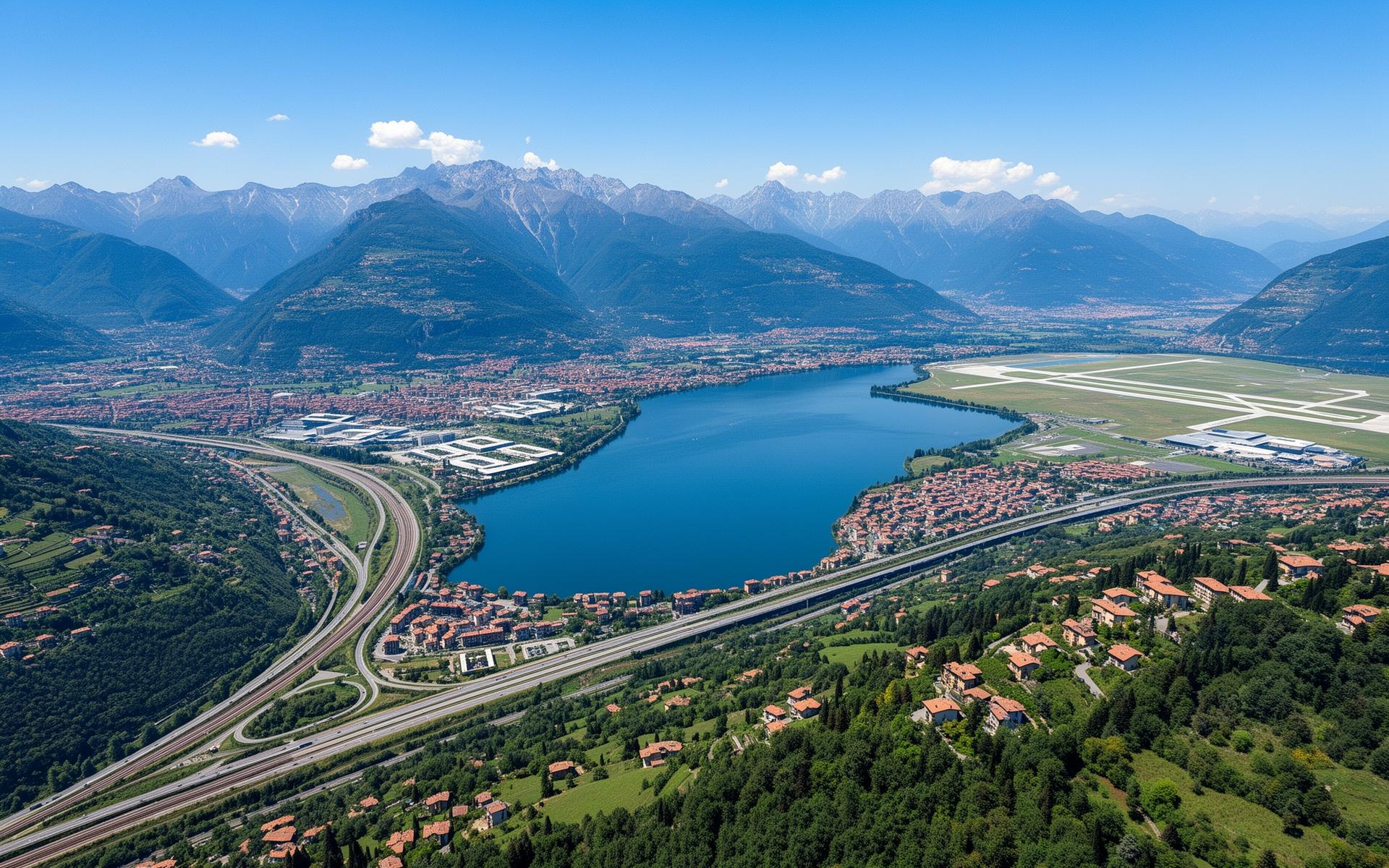
The Italian National Recovery and Resilience Plan (NRRP), backed by €191.5 billion from the EU Recovery Fund, is reshaping the country's infrastructure landscape. The Piemonte region, home to Agrate Conturbia, stands to benefit significantly.
Key Infrastructure Projects
Rail Connectivity
- •High-speed rail expansion connecting Turin-Milan corridor
- •Regional rail modernization reducing commute times by 40%
- •€2.1 billion allocated for Piemonte rail infrastructure
Road Network
- •A26 motorway improvements enhancing Lake Maggiore access
- •New bypass roads reducing Milan airport transit time
- •Smart highway integration with digital traffic management
Airport Expansion
- •Malpensa Airport Terminal 3 development
- •Increased capacity to 40 million passengers annually
- •Direct implications for tourism and business travel
Impact on Property Values
Historical data shows infrastructure investment correlates strongly with property appreciation:
- •Ranges of 15-25% are commonly cited for areas within 30 minutes of major transport hubs; the effect size varies by market and is not verified for this corridor
- •Studies of new rail stations typically report 8-12% uplift in nearby values within five years, with wide confidence intervals
- •Improved airport access is associated with stronger demand in prime residential markets, though causation is difficult to isolate
Estimate, not a verified local measurement. Sources are listed at the end of this article.
Strategic Timing
The 2025-2030 delivery programme defines the window in three stages:
- •Current entry prices don't fully reflect planned improvements
- •Construction phase creates temporary undervaluation
- •Completion phase sees rapid value appreciation
What Is Funded, and What Is Only Announced
Infrastructure announcements and infrastructure funding are different things, and the distinction matters for anyone underwriting a location:
| Status | What it means | How we treat it |
|---|---|---|
| Contracted and financed | Works tendered, budget assigned in the NRRP or in the RFI/ANAS investment plans | Counted in the base case |
| Programmed | Included in a regional or national plan, budget indicated, tender not awarded | Counted only in the upside case |
| Announced | Political commitment or feasibility study only | Not counted |
The €4.2 billion figure used in public commentary for this corridor aggregates all three categories. A disciplined reading separates them before any value conclusion is drawn.
Delivery Risk
Italy's NRRP works to a hard EU deadline, and independent monitoring has repeatedly flagged slippage in the construction pipeline. Three risks are relevant here:
- •Schedule risk — tender delays and contractor capacity constraints push completion beyond the 2026 milestones.
- •Cost risk — construction cost inflation since 2021 has forced re-scoping of several regional programmes.
- •Scope risk — projects can be reduced rather than cancelled, which weakens the connectivity benefit without appearing as a failure.
None of these invalidate the corridor thesis. They do mean that travel-time improvements should be treated as a scenario, not as a scheduled fact.
What We Monitor
- •Award notices and progress reporting for A26 and Malpensa works
- •Regional rail timetable changes, which are the observable proof that a works programme has delivered
- •OMI half-yearly price series for the comuni along the corridor, to test whether any premium is actually appearing
Why Agrate Conturbia Benefits
Our location is positioned to capture multiple infrastructure improvements:
- •25 minutes to Malpensa Airport (improving to 20 minutes)
- •60 minutes to Milan city center (improving to 45 minutes)
- •Direct access to Lake Maggiore recreational areas
The infrastructure investment thesis strongly supports our development timeline.
Sources and verification
Primary sources consulted
- Governo Italiano — Italia Domani — PNRR mission and milestone documentation italiadomani.gov.it
- Regione Piemonte — Territorial and planning documentation (PTR, PPR) regione.piemonte.it
- ISTAT — Demography, housing and regional accounts series istat.it
- OECD — Regional wellbeing and housing indicators oecd.org
Figures presented as ranges, uplifts or returns are model estimates based on the sources below. They are not measurements of this site and not a promise of performance.
Read the Journal by interest rather than by publication date. Each path is a sequence, not an archive.
The regional brief
5 articlesNorthern Italy read as a residential and investment region rather than as a holiday destination.
You are here · Step 1 of 5
- 1Northern Italy as a European Residential and Investment Region
- 2The Milan–Lake Maggiore–Swiss CorridorIn research
- 3Why Piedmont Remains Less Expensive Than Better-Known Italian Regions
- 4Climate, Landscape and Year-Round Liveability in Northern ItalyIn research
- 5Can Piedmont Become a Global Lifestyle Destination?
The investor journey
8 articlesFrom how development value is created before construction to how integrated schemes are underwritten.
- 1How Land Consolidation Creates Development Value
- 2Why Planning Rights Can Be More Valuable Than Construction
- 3Senior Secured Development Finance Explained
- 4How Institutional Investors Assess Integrated Developments
- 5Why Phasing Matters More Than the Final Masterplan
- 6Does Combining Residential, Hospitality, Wellness and Sport Actually Work?
- 7What Can Go Wrong in a Multi-Use Lifestyle Development?In research
- 8The Integrated Community as a Long-Term Investment and Living ModelIn research
The living journey
8 articlesWhat changes in how people want to live, and what a low-density community must deliver in return.
- 1Why Affluent Households Are Reconsidering Large-City LivingIn research
- 2Luxury Is Becoming Time, Privacy and ConvenienceIn research
- 3The Rise of the 15-Minute Lifestyle Beyond the CityIn research
- 4Why Nature Is Becoming an Economic AssetIn research
- 5From Second Home to Second LifeIn research
- 6How Far Are People Actually Willing to Walk?In research
- 7Why Residential Value Depends on Everything Outside the Home
- 8How a Large Estate Can Feel IntimateIn research
The operator journey
7 articlesDemand, seasonality and critical mass for hospitality, wellness, sport and food & beverage.
- 1Why Hospitality Can Accelerate Residential Demand
- 2Can Hotels and Permanent Residents Successfully Share One Destination?In research
- 3The Economics of a Food and Beverage EcosystemIn research
- 4From Spa to Everyday WellnessIn research
- 5Who Pays for Wellness and Why?In research
- 6Can Sport Reduce Seasonality?
- 7How Much Population Does an Integrated Community Need?In research
Why Northern Italy
Article 1 of 5From Second Home to Second Life
The Milan–Lake Maggiore–Swiss Corridor